
How to File a California Mechanics Lien: Step-by-Step Legal Guide

Getting paid for construction work can be challenging when property owners or general contractors refuse to pay. A mechanics lien is a constitutional right in California that secures your unpaid debt against the property’s value. This legal claim makes it difficult for the owner to refinance, sell, or transfer the property until you receive payment.
Filing a mechanics lien in California involves strict deadlines that will make or break your case. Direct contractors have 90 days after project completion or 60 days after a Notice of Completion is recorded to file their lien. Subcontractors and others not hired directly by the property owner face tighter deadlines: 90 days after completion or just 30 days after a Notice of Completion is recorded. Most importantly, even after recording your lien, you must file a lawsuit within 90 days to enforce it, or your lien becomes invalid.
What happens if you miss these deadlines? You lose your lien rights entirely.
In this post we discuss the five essential steps to file a California mechanics lien properly. We cover eligibility requirements, preliminary notice obligations, form preparation, recording procedures, and enforcement deadlines. Property owners should also understand this process to address payment disputes before they escalate into lien claims.
Step 1: Confirm Eligibility to File a California Mechanics Lien
Not everyone who works on a construction project can file a mechanics lien. California Civil Code §8400 defines specific eligibility requirements, and violating these rules will invalidate your claim.
Who Qualifies Under Civil Code §8400
California Civil Code §8400 grants lien rights to those who provide work for a construction improvement:
- Direct contractors (general contractors)
- Subcontractors
- Material suppliers
- Equipment lessors
- Laborers
- Design professionals (architects, engineers, etc.)
To qualify as a valid claimant, you must make a direct contribution to a specific work improvement with proper authorization. This authorization comes from the property owner or someone in charge of the project, such as a general contractor or architect. Only direct participants in the construction project qualify—those indirectly involved cannot file a mechanics lien.
Unlicensed Contractor Restrictions
California takes contractor licensing seriously. If your work requires a contractor’s license under California law, being unlicensed creates major legal problems.
Unlicensed contractors cannot foreclose on a mechanics lien if the work is valued at more than $500. California law goes further—if you perform work requiring a license without having one, you cannot file a valid mechanics lien and cannot sue to recover payment at all.
Contracting without a required license constitutes a misdemeanor crime. If you’re sued as an unlicensed contractor, you may have to return all compensation already paid to you.
One exception exists for “handyman” work, which may allow lien rights without a license. This exception applies only when the total job cost (including both labor and materials) doesn’t exceed $500. This $500 limit remains fixed even when performing multiple tasks simultaneously.
Design Professional Lien Rights
Architects, engineers, and other design professionals have unique lien rights in California. They can file standard mechanics liens like other construction participants, but they also have access to a special “design professional lien” that applies before construction begins.
Design professionals typically need a written contract directly with the property owner to qualify for these special liens. Design professional liens don’t apply to single-family, owner-occupied residences with construction costs under $100,000.
To file a design professional lien, follow these steps:
- Send a written demand to the owner by certified mail specifying the payment default
- Wait 10 days after sending this notice
- Record the lien at the County Recorder’s office
These liens must be recorded within 90 days after the design professional knows the landowner isn’t proceeding with the project. The lien automatically expires 90 days after recording unless you file a lawsuit to enforce it.
Filing a design professional lien doesn’t prevent you from later filing a standard mechanics lien once construction begins. This gives design professionals additional protection for their work.
Step 2: Serve the 20-Day Preliminary Notice (If Required)
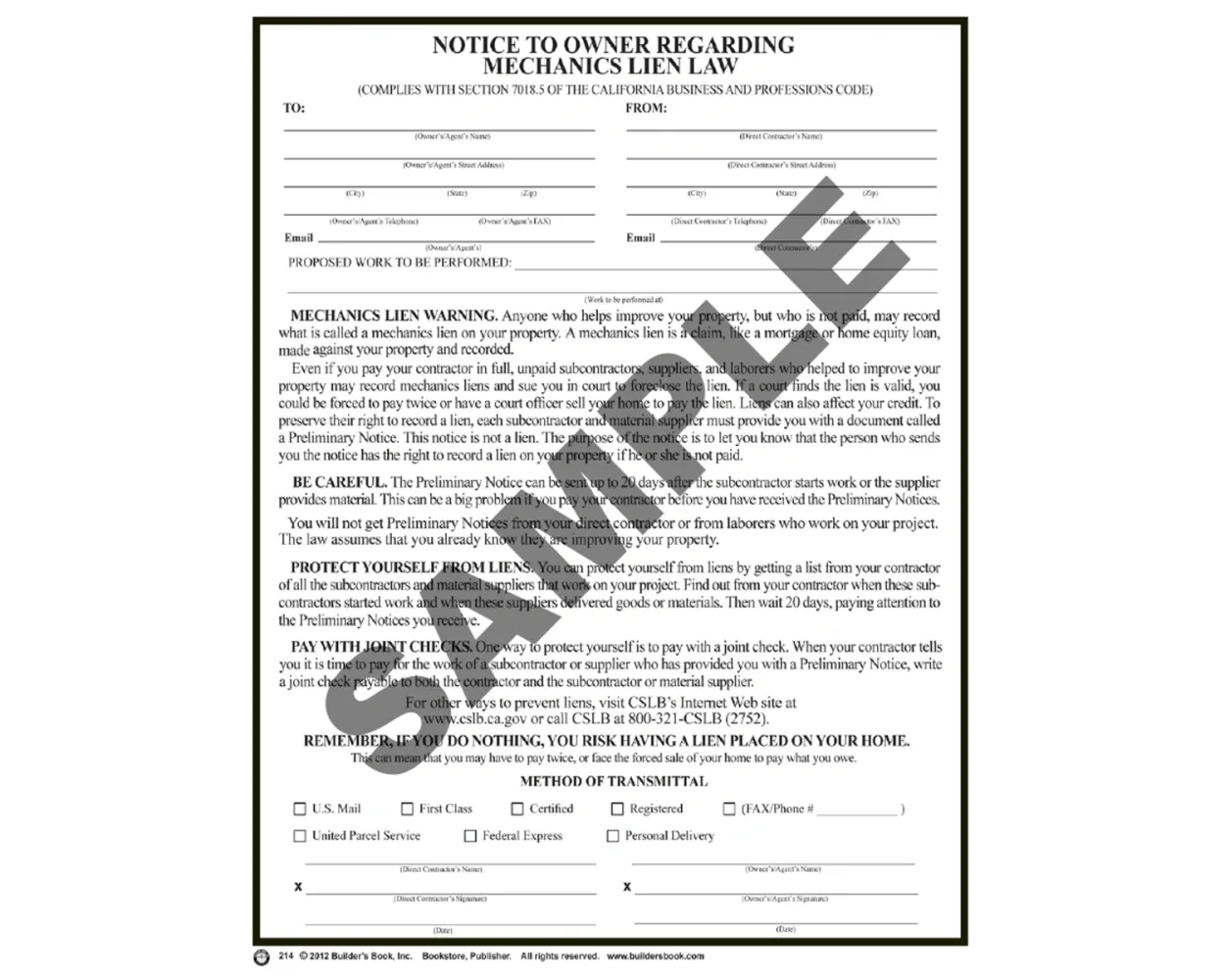
Image Source: Builder’s Book
After confirming your eligibility, serving a preliminary notice becomes the critical next step in securing your right to file a California mechanics lien. This document serves as official notification to key project stakeholders about your involvement and potential lien rights.
Who must serve a preliminary notice
Subcontractors and suppliers must always serve preliminary notices. Direct contractors (general contractors) need only serve preliminary notices to construction lenders, if any. Laborers are exempt from the preliminary notice requirement.
For private projects, the preliminary notice must be sent to the property owner, general contractor, and construction lender (if applicable). Civil Code §8200 makes this notice a necessary prerequisite to the validity of your lien claim, stop payment notice, or payment bond claim. Failing to send a preliminary notice essentially forfeits your right to file a mechanics lien.
Deadline: 20 days from first furnishing labor or materials
California law requires contractors and suppliers to send this document within the first 20 days of starting work or delivering materials to the project. This strict timeline begins when you first provide labor or materials—not when the project is completed.
What happens if you miss this deadline? You don’t lose all lien rights, but your protection becomes significantly limited. If you serve a late preliminary notice, you can only claim payment for:
- Work performed within 20 days prior to sending the notice
- Any work performed after the notice was sent
This restriction can substantially reduce your ability to recover payment for earlier work. Failing to comply might also lead to disciplinary action from the Contractors State License Board.
Delivery methods: Certified mail and proof of service
According to Civil Code §8110, you must use one of these methods:
- Registered mail
- Certified mail
- Express mail
- Overnight delivery by an express service carrier
Most construction professionals choose certified mail since it provides crucial documentation of delivery. When sending via certified mail, the postmark date becomes essential—the recipients don’t need to have the notice delivered within 20 days, only sent within that timeframe.
To properly document your compliance, maintain these records:
- A copy of the notice you mailed
- Affidavit or declaration of mailing
- Tracking number and delivery status log
- Certificate of mailing from the post office
The law has been updated since 2012, and now you can prove service through various documentation, including payment proof for certified mail or tracking records showing delivery.
Proper delivery and documentation of your preliminary notice are legal necessities that directly affect your ability to secure payment through a mechanics lien.
Step 3: Prepare the California Mechanics Lien Form
Preparing an accurate mechanics lien form is critical for protecting your payment rights. The form must include specific information and follow statutory requirements to create a valid claim. Incorrect information could invalidate your entire lien.
Required Information Under Civil Code §8416(a)
California Civil Code §8416(a) mandates that your mechanics lien must contain these essential elements:
- Your demand amount after deducting credits and offsets
- The property owner’s name (or reputed owner if known)
- A general statement describing your work or materials
- Name of the person who hired you
- Description of the property sufficient for identification
- Your business name and address
- Proof of service affidavit showing the lien was served
- The statutory notice in at least 10-point boldface type
The form must be signed and verified by you as the claimant. California doesn’t require notarization, but accuracy is paramount. Missing or incorrect information will most likely invalidate your claim.
Property Description and Work Details
California requires only “a description sufficient for identification” for the property. A street address is generally acceptable, but including a complete legal description provides stronger protection. This extra detail ensures your lien clearly identifies the correct property.
Describe your work with specificity. Detail the labor, materials, or services you provided without exaggeration. The description should clearly connect your contribution to the improvement of the property. Vague descriptions create opportunities for challenges to your lien.
Lien Amount Limitations Under §8430
Your lien amount must follow strict guidelines under Civil Code §8430. The lien is limited to the lesser of:
- The reasonable value of your work, or
- The price agreed to in your contract
You cannot include consequential damages, lost profits, delay damages, or attorney’s fees in your lien amount. Intentionally inflating the lien amount risks invalidation by the court. You may include work performed under written change orders or resulting from contract breach.
California Mechanics Lien Form Templates
Free California mechanics lien form PDF templates are available from reputable sources. These templates ensure your document meets all statutory requirements, especially the mandatory notice language in 10-point boldface type.
Any form you use must comply with California Civil Code §8416. Using professionally prepared templates reduces the risk of technical errors that could jeopardize your lien rights. The statutory notice language is particularly important – it must be exactly correct and properly formatted.
Step 4: Serve and Record the Mechanics Lien
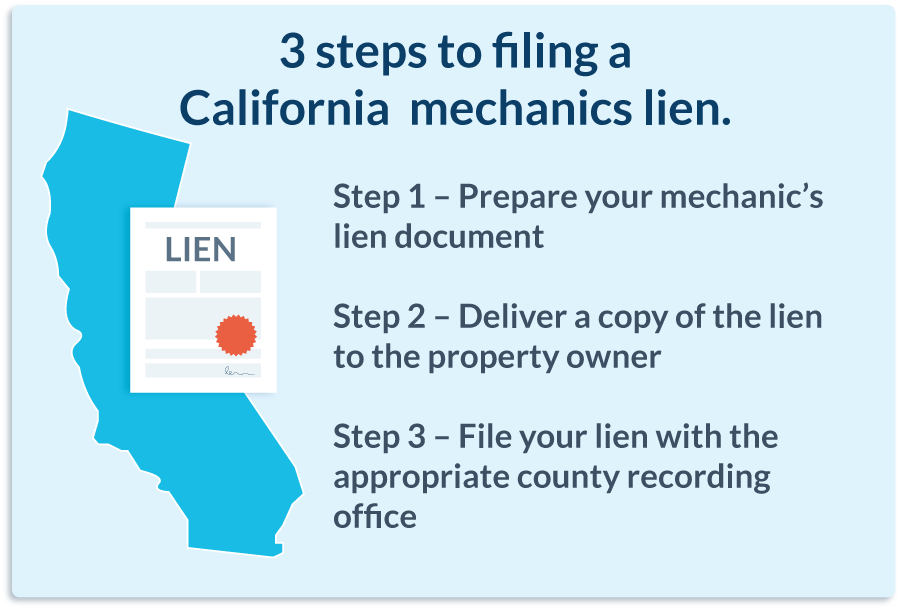
Image Source: Levelset
Filing your California mechanics lien requires two distinct steps that must be completed in the correct order. Service comes first, then recording. Missing either step or doing them out of order will invalidate your lien entirely.
Serving the lien before recording
California law requires you to serve a copy of your mechanics lien on the property owner before recording it with the county. This service must include both the mechanics lien and the Notice of Mechanics Lien.
To properly serve your lien, use one of these approved methods:
- Certified mail with return receipt requested
- Registered mail
- First-class mail with certificate of mailing
If you cannot locate the property owner, you must serve the lien on either the construction lender or the original contractor. After service, complete a proof of service affidavit that must be included when recording your lien.
Failure to serve the mechanics lien properly makes it completely unenforceable under California law. The lien will be invalid regardless of how much money you are owed.
Where to record: County recorder of project location
The mechanics lien must be recorded with the county recorder’s office in the county where the construction project is located. Each California county has its own recorder’s office with requirements that vary from county to county.
It is important to identify the correct county recorder’s office before attempting to file. The recording office must be the one specifically designated for filing mechanics liens.
Recording fees and formatting requirements
Recording fees vary by county throughout California. The base recording fee typically ranges from $14-$20 for the first page plus $3 for each additional page. Additional fees may apply:
- Real Estate Fraud fee: $5-$10
- Building Homes and Jobs Act fee: $75 (with some exemptions)
- Restrictive Covenant Modification Program fee: $2
- Involuntary lien notification fee: $7-$9 per debtor
County recorders require standard 8.5″ x 11″ document size. Non-standard sizes may result in substantially higher fees, sometimes up to $92 for the first page.
You may purchase certified copies during recording for future reference, typically costing $6 for the first page plus $3 for each additional page.
Step 5: Enforce or Release the Lien Within Legal Deadlines
Recording your mechanics lien is not the end of the process. You have critical obligations that will determine whether your lien rights survive or expire.
90-Day Enforcement Deadline After Recording
A mechanics lien in California must be enforced through a foreclosure lawsuit within 90 days after recording. Missing this deadline means your lien automatically expires and becomes unenforceable by law. Even with a valid claim, failing to meet this 90-day window voids your lien rights entirely.
The 90-day clock starts ticking the moment your lien is recorded with the county recorder’s office. There are no exceptions to this rule without proper legal extensions.
Extension of Credit and Enforcement Timeline
You can extend the enforcement deadline by recording a Notice of Extension of Credit before the original 90-day period expires. This document must be signed by both you and the property owner and must specify the exact additional time granted.
Even with an extension, you must still file your enforcement action within 90 days after the credit period ends, and never later than one year after project completion. The extension does not eliminate the ultimate one-year deadline.
Releasing the Lien After Payment
Once you receive payment, you should release the lien immediately by filing a lien release with the county recorder’s office where the original lien was recorded. Provide written confirmation of payment to clear the property title.
Prompt release protects you from potential liability and maintains professional relationships with property owners and other contractors.
Consequences of Failing to Release an Invalid Lien
Invalid liens can prevent property owners from selling, refinancing, or obtaining credit on their property. Property owners have legal remedies if you don’t remove an invalid lien after receiving a written request:
- Petition the court for a release order
- Recover reasonable attorney’s fees incurred in the process
- File a release bond for 125% of the lien amount to clear the title while the dispute continues
Failing to release an invalid or paid lien can expose you to liability for damages and attorney’s fees.
Property owners and contractors dealing with lien issues should also review our guide to California construction defect claims, our construction and development contracts practice page, and our walkthrough on removing title defects and clouds on title in California when an expired or invalid lien is blocking a sale or refinance.
Filing a California Mechanics Lien: What You Need to Know
Filing a California mechanics lien most likely will protect your payment rights if you follow the rules precisely. Missing even one deadline or requirement will invalidate your entire claim.
The process involves five essential steps: confirming eligibility, serving preliminary notices, preparing the lien form correctly, recording it properly, and enforcing or releasing it within legal deadlines. Each step has specific requirements that must be followed exactly.
What is the most common mistake? Missing the 90-day enforcement deadline after recording the lien.
Property owners should understand this process as well. Knowing how mechanics liens work helps you address payment disputes before they become legal claims against your property.
Mechanics liens exist as a constitutional right in California. The legal system provides this tool to ensure construction professionals receive payment for their work. Generally speaking, contractors who follow the statutory requirements will have a strong claim for payment.
With proper preparation and attention to deadlines, you can use California’s mechanics lien laws to secure what you’ve earned. The key is acting quickly and following each step correctly.
People Also Ask
Q1. What are the key steps to file a mechanics lien in California? The main steps include confirming eligibility, serving a preliminary notice if required, preparing the lien form with all necessary information, serving the lien on the property owner, and then recording it with the county recorder’s office. After recording, you must enforce the lien by filing a lawsuit within 90 days or release it once paid.
Q2. Is there a deadline for filing a mechanics lien in California? Yes, there are strict deadlines. For direct contractors, the deadline is 90 days after project completion or 60 days after a Notice of Completion is recorded. Subcontractors and suppliers have 90 days after completion or 30 days after a Notice of Completion is recorded. Missing these deadlines can invalidate your lien rights.
Q3. How much does it cost to file a mechanics lien in California? The cost varies by county but typically includes a base recording fee of $14-$20 for the first page plus $3 for each additional page. Additional fees may apply, such as a Real Estate Fraud fee, Building Homes and Jobs Act fee, and others. Total costs can range from around $100 to $150 depending on the specific county and document length.
Q4. Can I file a mechanics lien without an attorney in California? While it’s legally possible to file a mechanics lien without an attorney, it’s generally not recommended due to the complexity of the process and strict legal requirements. Mistakes in filing can invalidate your lien, so professional legal assistance is advisable to ensure compliance with all regulations.
Q5. What happens if I don’t enforce or release a mechanics lien in California? If you don’t enforce your lien by filing a lawsuit within 90 days of recording, it automatically expires and becomes unenforceable. Failing to release an invalid or paid lien can lead to legal consequences, including the property owner petitioning the court for a release order and potentially recovering attorney’s fees from you.
Protect Your Property Rights — Schedule a Consultation
Whether you are a property owner fighting an inflated or expired lien that is blocking a sale, or a contractor who needs a lien perfected and enforced before the deadlines run, the procedural details decide these cases. Borna Houman Law represents property owners, developers, and contractors across Beverly Hills, Santa Monica, West Los Angeles, and all of Los Angeles County. Call (888) 42-BORNA to schedule a confidential consultation.

